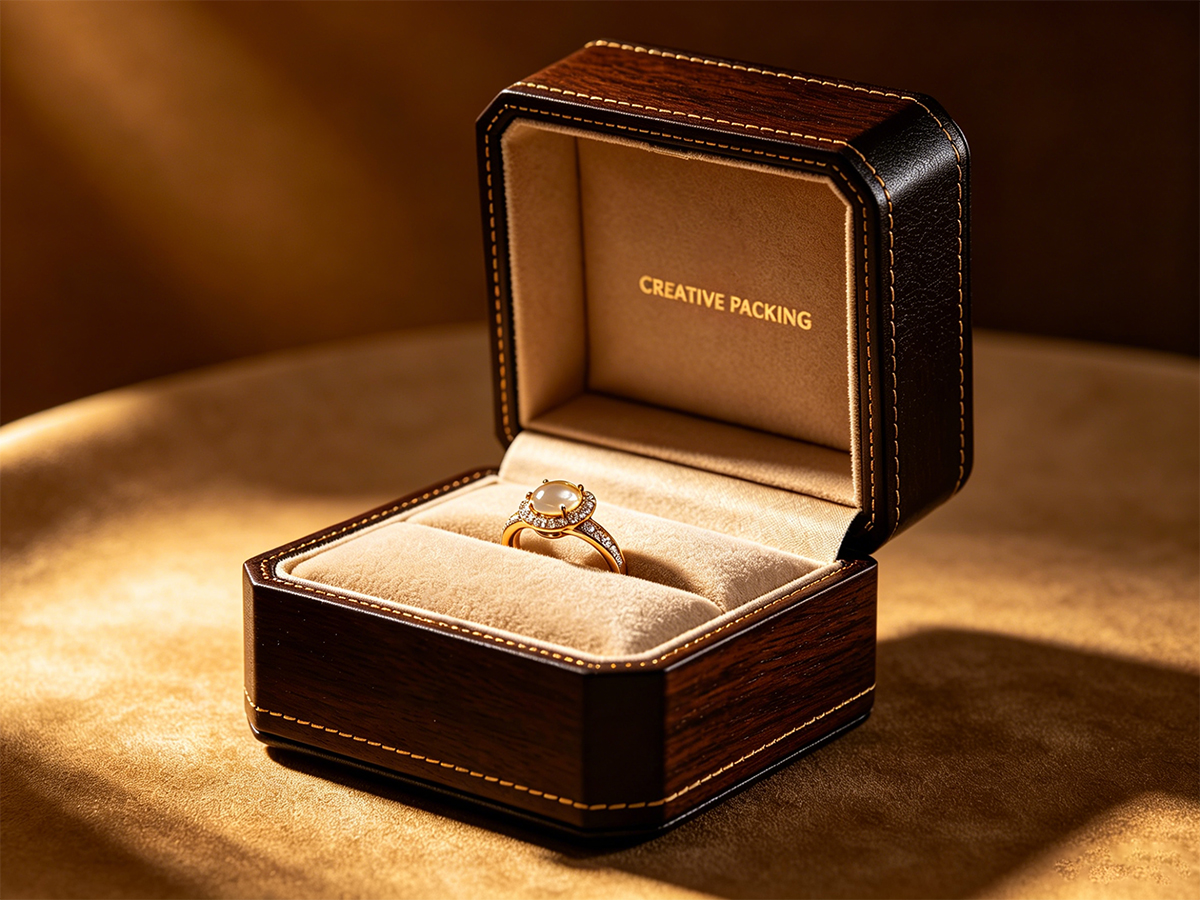
When customizing jewelry boxes, many clients notice a common phenomenon: the larger the order quantity, the lower the unit price tends to be.
This is not simply because “buying more is cheaper,” but because custom production involves substantial fixed costs. As the order quantity increases, these fixed costs are spread across more units, resulting in a lower unit price per box.
1. Mold Opening and Sampling Costs Are Amortized
Custom jewelry boxes usually require sampling, process confirmation, and structural adjustments. Some designs also need custom molds or special cutting dies.
These upfront costs occur regardless of whether the order is for 100 or 10,000 pieces. When the order quantity is small, these costs are distributed across fewer units, making the unit price significantly higher.
As the order quantity increases, the upfront investment remains relatively stable while the number of finished products grows, so the average unit price decreases. This is why factories are generally more inclined to accept bulk orders.
2. Production Efficiency Affects Quotation
Small-batch orders often require frequent equipment adjustments and process changes, resulting in lower production efficiency.
Large-volume orders, on the other hand, allow for continuous production, reducing downtime and setup time, which greatly improves overall efficiency. Higher efficiency makes it easier to control labor and time costs.
For jewelry boxes that involve multiple processes, larger orders lead to more stable production and offer greater room for competitive pricing. Therefore, quantity not only affects costs but also influences the factory’s pricing strategy.
3. Bulk Procurement Offers Better Raw Material Advantages
During mass production, factories can purchase larger quantities of paperboard, fabrics, linings, and hardware in a single order. Bulk purchasing usually secures lower unit prices for raw materials.
Small orders, by contrast, are often calculated at higher spot purchase prices. Although the difference in raw material costs may seem small, when distributed across each jewelry box, it creates a noticeable impact on the final unit price. The larger the order quantity, the more significant the cost advantage in raw materials.
4. Smaller Quantities Lead to Greater Price Fluctuations
In the custom jewelry box industry, unit prices for small-batch orders tend to fluctuate more. This is because, in addition to materials and labor, small orders carry higher management and communication costs.
If the craftsmanship is complex or frequent revisions are required, the unit price can rise even further. Large-volume orders, however, allow for more standardized production processes and more stable quotations.
Therefore, when making budgets, it is best to first clarify the required quantity before comparing different options.
5. Different Order Quantities Suit Different Solutions
Not all projects should start with large volumes.
If a brand is still testing the market, it is recommended to begin with small to medium batches for sampling or initial orders, then scale up after confirming design, craftsmanship, and market feedback. This approach reduces trial-and-error costs and helps control inventory risk.
For established brands, festive gift boxes, or long-term supply projects, large-volume customization usually provides better price advantages.
Order quantity is therefore not just a pricing matter — it also relates to overall procurement strategy and inventory planning.
6. Clearly State Quantity and Requirements When Inquiring
To receive a more accurate quotation for custom jewelry boxes, it is best to clearly provide the following information when inquiring:
- Required order quantity
- Jewelry box dimensions
- Material and craftsmanship requirements
- Interior lining and hardware configuration
- Any brand logo customization needs
The more complete the information, the easier it is for the factory to assess costs and provide reasonable tiered quotations.
For custom products, order quantity is a key factor affecting unit price. You should not judge solely by surface-level quotes.
If you are looking for a reliable custom jewelry box manufacturer, please feel free to share your order quantity, dimensions, material requirements, and craftsmanship needs. We will quickly calculate unit prices and provide suitable bulk customization solutions tailored to your brand.
Read more:




 Release time:

 WhatsApp: