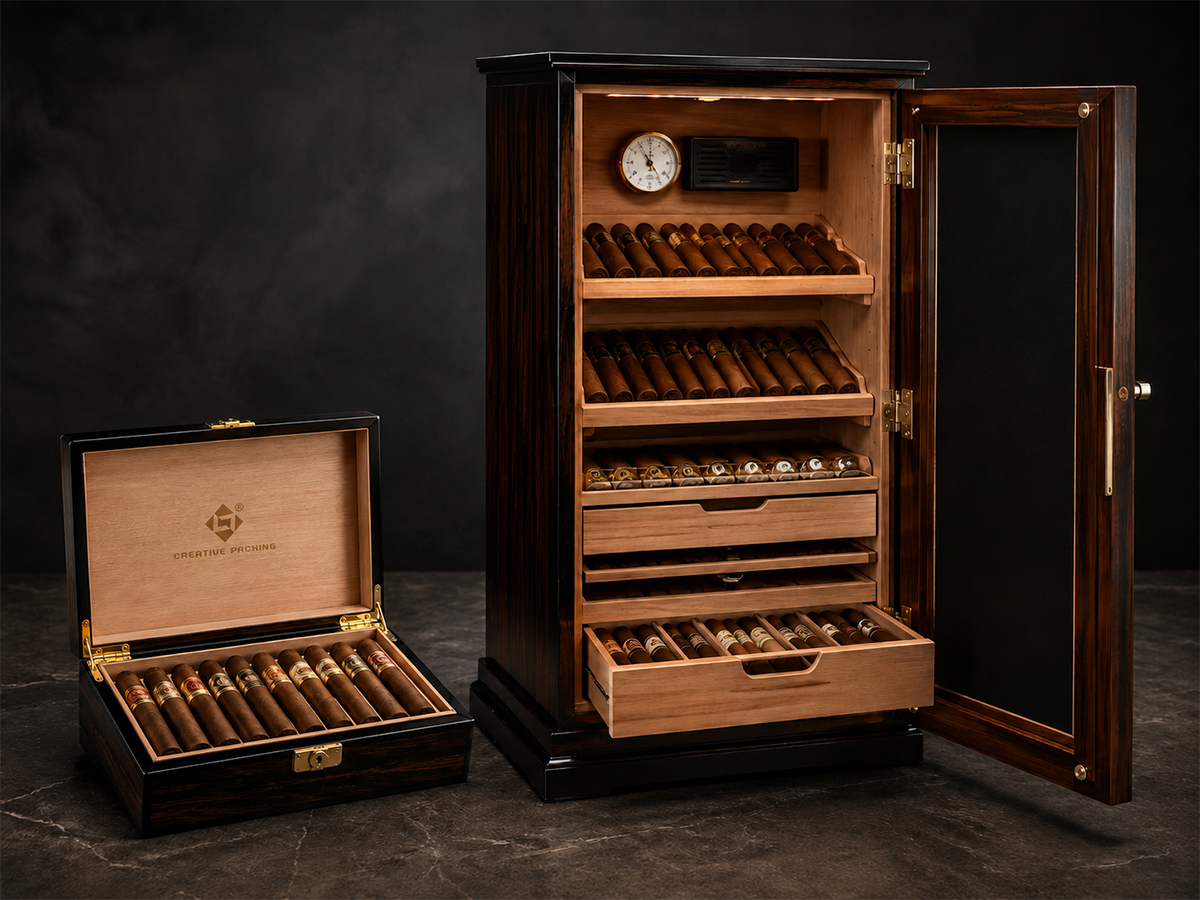
Quick answer: A cigar box and a humidor are not the same product, even when they look nearly identical in a photo. A cigar box is built for presentation and short-term transport; a humidor is built with solid Spanish cedar, a properly fitted seal, and a humidification system to protect cigars over months or years. Ordering the wrong one for the intended use is a common, and expensive, sourcing mistake.
Is a Well-Made Cigar Box the Same as a Humidor?
No — and the difference isn't cosmetic. A regular cigar box, even a nicely finished one, typically lacks the airtight fitted seal, the solid cedar wall thickness, and the humidification hardware that a humidor needs to hold a stable interior climate for the long term. Cigar boxes are commonly lined with a thin cedar veneer rather than solid cedar planking, which looks similar on day one but doesn't perform the same way after a year of seasonal humidity changes.
What Actually Separates the Two Structurally?
Wall and lining thickness. Solid Spanish cedar planking, the same construction used in our wooden cigar boxes, retains and regulates moisture far more effectively than a thin veneer glued over a base material like particleboard or MDF. The thicker the cedar layer, the more buffering capacity the box has against humidity swings.
Seal quality — and it isn't about being airtight. A common misconception is that a humidor should seal completely hermetically. It shouldn't. Cigars need occasional fresh air exchange to avoid staleness, so the goal is a tight, well-fitted seal that holds a stable internal humidity without escaping quickly — not a vacuum-sealed box.
Hinge durability. A humidor's lid gets opened and closed far more often over its lifespan than a gift box does. Hinges need to hold their fit under repeated use without loosening the seal over time — a detail that's easy to under-spec on a box designed primarily to look good in a first impression.
Humidification system and hygrometer. This is the most visible difference: a humidor includes a way to actively maintain humidity (a passive humidification device at minimum) and a hygrometer to monitor it. A cigar box generally does not, because it isn't designed for extended unattended storage.
Does Every Order Actually Need a Full Humidor Build?
Not necessarily — and this is where sourcing decisions go wrong in both directions. A promotional cigar box meant to hold a gift set for a few weeks in transit and initial use doesn't need full humidor-grade construction, and specifying it anyway adds unnecessary cost. A retail or collector product that customers are expected to store cigars in for months does need it, and specifying a standard cigar box for that purpose sets the product up to fail exactly the way it's used.
Comparing the Three Common Tiers
| Tier |
Construction |
Humidity Control |
Best Suited For |
| Gift/Presentation Cigar Box |
Thin cedar veneer over MDF or similar base, decorative seal — or a leather-wrapped exterior over a simple wood core |
None or minimal |
Short-term transport, retail gifting, promotional sets |
| Standard Humidor Box |
Solid cedar lining, fitted seal, basic hinges |
Passive humidification device + hygrometer |
Personal or small-collection storage, mid-tier brand SKUs |
| Premium/Cabinet Humidor |
Thick solid cedar, engineered seal, reinforced hinges |
Active or advanced passive system, zoned humidity |
Long-term collector storage, flagship retail display, hospitality use |
Frequently Asked Questions
Can a nice-looking cigar box be upgraded into a humidor later? Sometimes, with cedar lining added and a humidification device installed — but retrofitting a seal that was never engineered to hold humidity is inconsistent at best, and it's rarely as reliable as specifying the right construction from the start.
Does a brand need to explain this distinction to its own customers? It's worth it for any product marketed with storage claims — if packaging is described as protecting cigars long-term, it should actually be built to do that, or the claim creates a service problem down the line.
Is solid cedar always necessary, or is veneer acceptable? Veneer is acceptable for short-term or presentation-only boxes. For anything marketed as protective storage, solid cedar is the standard that actually performs.
Conclusion
"Cigar box" and "humidor" get used almost interchangeably in casual conversation, but they're different engineering problems with different bills of materials. Creative Packing builds both — from presentation-grade wooden cigar boxes to fully humidified storage units — matched to what the product actually needs to do once it leaves the factory.
Read more:





 Release time:

 WhatsApp: