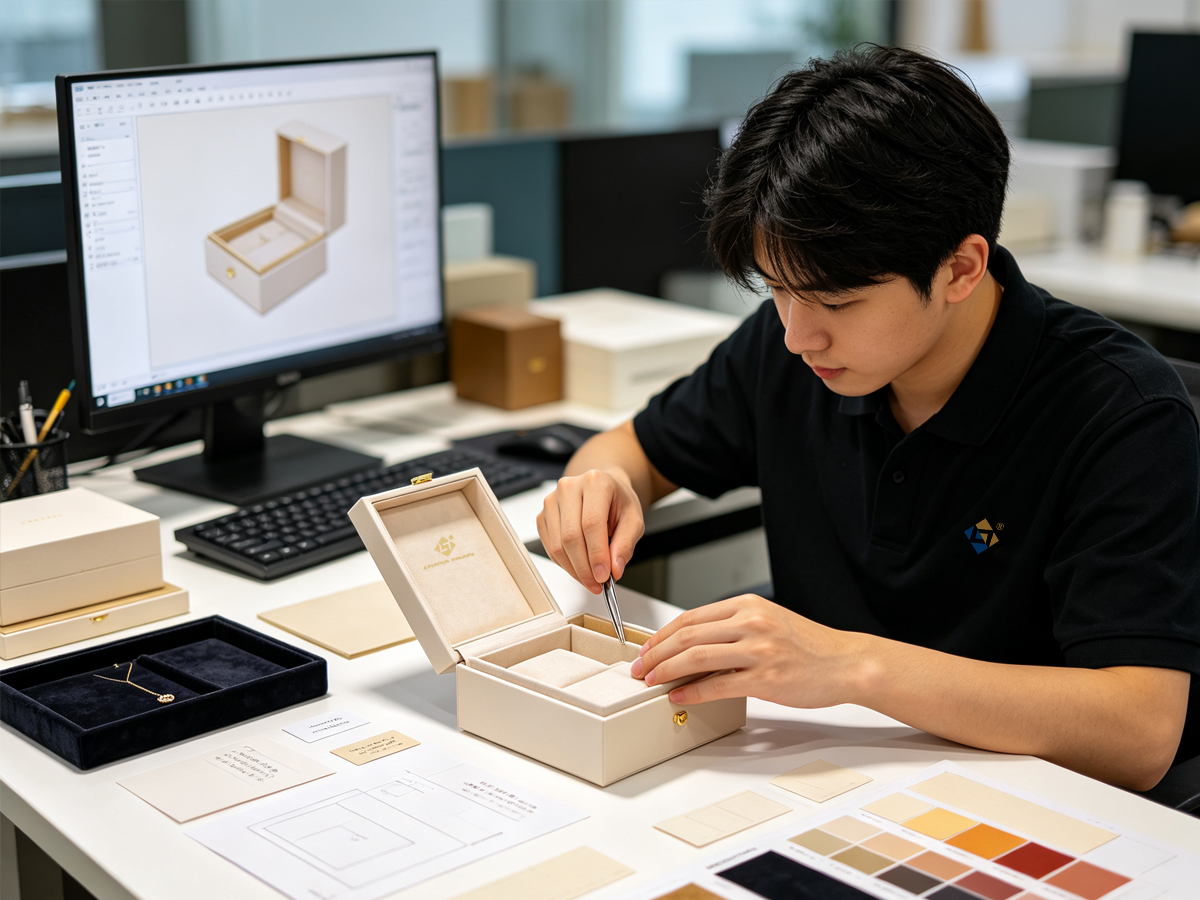
When customizing jewelry boxes, many clients focus heavily on the mass production quotation while overlooking the importance of sampling fees.
In reality, sampling is not only the process of confirming the final look — it is also a critical step to verify whether the design, dimensions, structure, and craftsmanship are feasible. If problems are not identified during the sampling stage, the cost of rework during mass production is often much higher.
1. Sampling Is an Essential Step to Confirm the Solution
The purpose of sampling goes beyond checking appearance. It is used to verify that the entire solution meets expectations, including whether the dimensions are appropriate, the structure is user-friendly, colors are accurate, and craftsmanship is up to standard.
For complex structures or high-end custom jewelry boxes, sampling is almost indispensable. If clients proceed directly to mass production without sampling, issues are likely to surface only after the finished goods are produced. At that point, modifications become far more costly and time-consuming.
2. Sampling Fees Are Closely Related to Craftsmanship Complexity
Sampling costs are not the same for all products. For jewelry boxes with simple structures and basic craftsmanship, sampling fees are usually lower.
However, if the project involves special box shapes, exclusive colors, complex surface finishing, or custom linings, sampling costs will rise significantly. Some samples require multiple rounds of adjustments, such as color confirmation, logo positioning corrections, or material replacements. Each modification adds time and labor costs.
3. Sampling Helps Reduce Risks in Mass Production
Many clients view sampling fees as unnecessary expenses, but the opposite is true. The greatest value of sampling is helping clients identify problems early.
Issues such as poor opening/closing feel, tight lining, color deviation, or unclear logos can be discovered and corrected at the sampling stage with much lower costs. If these problems only appear during mass production, the losses can be substantial.
Therefore, sampling fees are essentially a form of risk control cost.
4. Different Suppliers Have Different Sampling Policies
Some jewelry box factories charge a separate sampling fee, while others allow full or partial deduction after the mass production order is placed. Some suppliers adjust fees based on craftsmanship complexity, number of revisions, and modification scope.
Therefore, when inquiring, clients should not only ask about mass production pricing but also clearly understand the sampling policy. Failing to clarify this in advance can easily lead to budget discrepancies later.
5. Aim for Clear Confirmation During the Sampling Stage
To reduce repeated sampling, clients should provide complete and detailed requirements from the very beginning. This includes dimensions, materials, colors, craftsmanship, logo, lining, hardware, and box structure.
The clearer the requirements, the closer the sample will be to the final product, and the fewer revisions will be needed. Fewer sampling rounds mean higher overall efficiency and more controllable costs.
In short, when it comes to sampling, cheaper is not always better — accuracy saves more money.
6. Inquire About Sampling and Mass Production Separately
When requesting a quotation for custom jewelry boxes, it is recommended to ask about “sampling fees” and “mass production unit price” separately. This allows for a clearer understanding of the total project budget and easier comparison between different suppliers.
Additionally, clarify the sampling lead time, number of allowed revisions, and whether the fee is deductible from the mass production order. These details may seem minor, but they directly affect project progress and final costs.
For custom jewelry boxes, sampling is an essential step that cannot be skipped.
Conclusion If you are looking for a reliable custom jewelry box manufacturer, please feel free to share your dimensions, material requirements, craftsmanship needs, and order quantity. We will quickly calculate sampling fees and mass production quotations, and provide suitable customization solutions tailored to your brand positioning.
Read More:




 Release time:

 WhatsApp: